


Salt Lake City Cost of Living: What It Really Costs to Live Here
Explore real Salt Lake City cost of living—rent, home prices, utilities, groceries, and expenses for singles and families.
BRUCE BIGFORD |

Is Salt Lake City still an affordable mountain city, or has it quietly joined the "pricey" club? The truth sits in the middle:
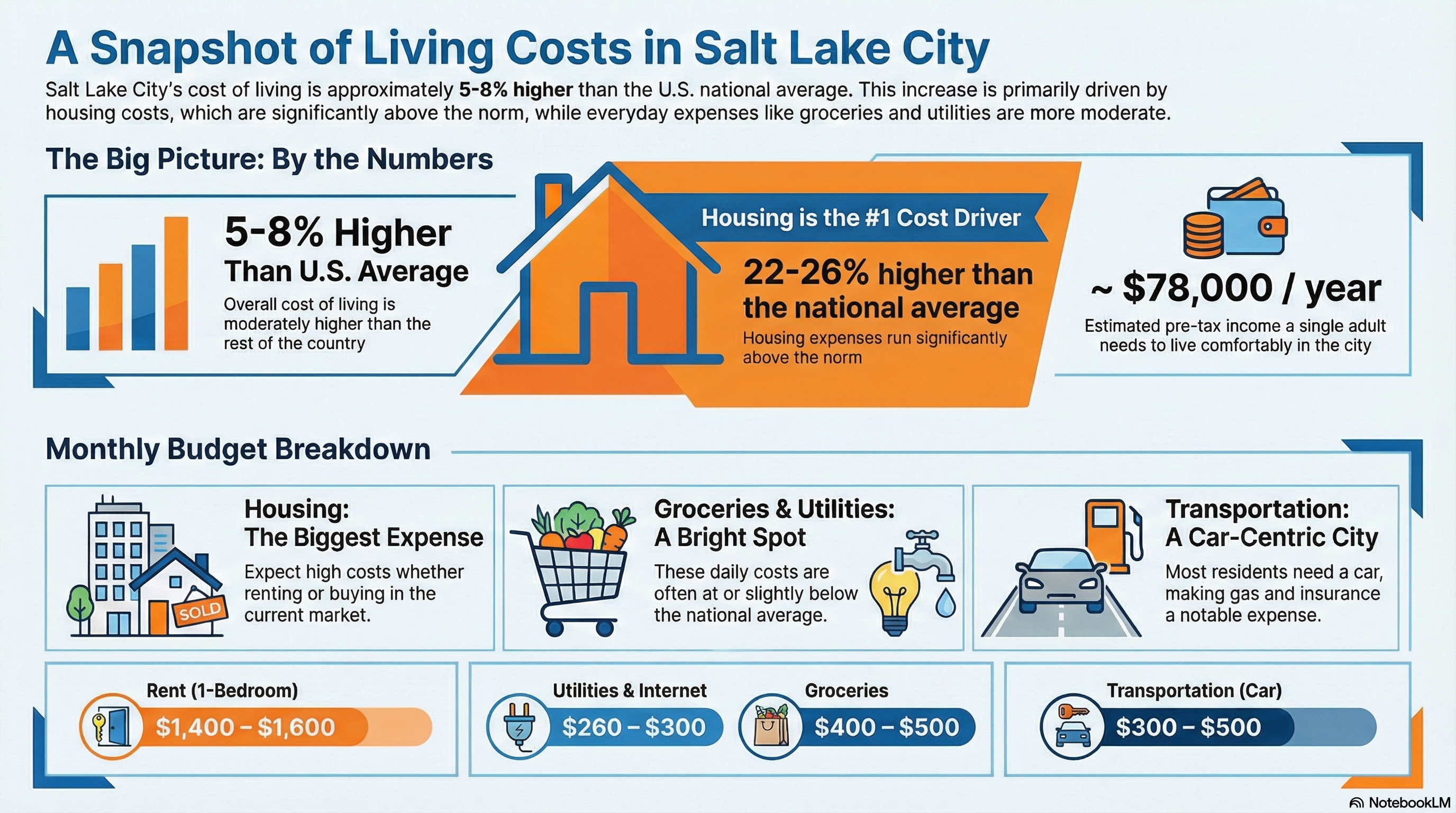
Living in Salt Lake City now costs a bit more than the national average, and housing is the main reason why. Overall cost-of-living calculators put Salt Lake City roughly 5–8% higher than the U.S. average, with housing running about 22–26% higher than typical.
Housing, transportation, and going out are where most newcomers feel the squeeze, while groceries and utilities are a bit more forgiving.
One popular estimate suggests a single adult in Salt Lake City needs around $78,000 per year before taxes to feel comfortable instead of just scraping by.
That number assumes you want to pay your bills, enjoy the city a little, and still save something each month. You can absolutely live here on less—but that usually means roommates, older apartments, or living a bit farther from the hottest neighborhoods.
Salt Lake City Cost of Living at a Glance (2026):
- Overall vs. U.S. average: 5–8% higher - Housing premium: 22–26% above national - Avg. 1-bedroom rent: $1,400–$1,600/month - Median home price: $600K–$700K - Family of 4 (est.): ~$5,800/month total (excl. housing) — dual incomes help offset - Monthly "comfortable" income (single adult): ~$78,000/year pre-tax - Groceries: Below national average (~$450–$500/month single) - Utilities (1–2 bed): $180–$230/month
Sources: Numbeo, NerdWallet cost-of-living indexes, and Salt Lake MLS real estate data (2026 estimates)
Housing costs in Salt Lake CityIf you're trying to understand the cost of living in Salt Lake City, start with housing
Recent rent data shows the average apartment in the city is in the mid-$1,500s per month, with smaller or older places below that and newer, amenity-packed buildings above it.
Studios often sit around the low-$1,200 range, one-bedrooms around the mid-$1,400s, and two-bedrooms pushing into the high-$1,700s or more, depending on location and building quality.
Neighborhood choice matters a lot for your personal cost of living in Salt Lake City. Trendy, central, or transit-friendly areas can easily add a few hundred dollars a month compared with more modest, slightly older neighborhoods.
If you're willing to trade newer finishes for a better price, you can shave down your rent significantly. On the flip side, if you want parking, mountain views, fancy balconies, in-unit laundry, and pet-friendly policies—the Salt Lake City cost of living you experience will look much steeper than citywide averages.
Buying a home is the other big shock. Many recent reports put typical home prices in the Salt Lake area around the mid-$600,000 to $700,000 range.
Over the last several years, prices have climbed fast as more people and jobs have poured into the region. If you're coming from a cheaper market, that jump can feel huge; if you're leaving somewhere like California or the Pacific Northwest, Salt Lake City may still feel like a "discount," but not a cheap one. Utilities, groceries, and monthly basicsOnce you get past the rent or mortgage, the next part of the Salt Lake City cost of living is all the "boring but unavoidable" stuff: utilities, internet, and food.
For a typical one-bedroom or small two-bedroom apartment, basic utilities (electricity, heating and cooling, water, trash) often land somewhere in the roughly $180 to $230 per month range. That's actually a bit lower than what many people pay in other parts of the country, which is surprising given
Utah's cold winters and hot summers. A solid home internet plan usually adds another $70 to $80 per month.
Groceries are a small bright spot in the cost of living in Salt Lake City. Many cost-of-living tools show grocery prices sitting a little below the national average.
In real-world terms, a single adult on a fairly budget-conscious plan might spend in the ballpark of $450 to $500 per month on groceries, more if you lean heavily into organic or specialty items. Families, of course, will spend more, but the underlying price level is not wildly out of line with typical U.S. cities. Transportation and getting aroundThe Salt Lake City cost of living also depends on how much you drive.
The metro area is still very car-centric, and that means gas, insurance, maintenance, and car payments can quietly become one of your biggest monthly costs.
Gas prices in Utah over the last few years have run higher than they used to, and while they move around, they've generally sat noticeably above the levels many people remember from the late 2010s. If you commute daily by car, your transportation budget can easily rival your grocery budget.
Public transit does exist—the TRAX light rail and buses can help cut down costs if you live and work near a line. However, most new arrivals still assume they'll need a car, at least for the first few years.
When you think about cost of living in Salt Lake City, it's smart to plan for both your housing and your transportation together: moving a little closer to work, or choosing a neighborhood with better transit, can sometimes save more than simply chasing the cheapest rent on the map.
What "comfortable" looks like in real lifeSo what does a realistic Salt Lake City cost of living picture look like for a single person renting their own place? A pretty typical, not-extravagant setup might include:
✔️ Rent: around $1,400 to $1,600 for a decent one-bedroom, more for something new and central, less if you're okay with a bit less. ✔️ Utilities and internet: roughly $260 to $300 combined each month. ✔️ Groceries: about $400-$500 a month on a modest but not bare- bones food budget. ✔️Transportation: Highly variable, but car payment + gas/insurance = $300–$500/month.
Once you factor in health insurance, phone service, a bit of eating out, and some savings, you can see why that "comfortable" income estimate around $78,000 a year pops up in cost-of-living breakdowns.
Someone who shares a place, drives a paid-off car, and keeps entertainment modest can live on less. Someone who wants a shiny new apartment, a newer car, and frequent nights out will feel like Salt Lake City got expensive very quickly.
Click to Enlarge FAQ Section
Is Salt Lake City expensive to live in?
Yes and no, about 5–8% above the U.S. average, driven by housing (22–26% higher). Groceries and utilities offset some pain, making it manageable for middle-income earners with roommates or modest choices.
What's the average rent in Salt Lake City?
Mid-$1,500s for apartments; studios ~$1,200, 1-beds ~$1,400s, 2-beds ~$1,700+. Central spots add $200–$400; older places a little less. Home rentals are higher. For houses and larger units, rent often exceeds $2,000 per month, with 3-bedroom units averaging between $2,330 and $2,700.
Can you buy a home in Salt Lake City on a single income?
Tough—median prices hit $600K–$700K. First-time buyers often need $100K+ down or partners; rentals are more realistic short-term.
How much are groceries in Salt Lake City?
A bright spot: Slightly below national average. Singles budget $450–$500/month; families scale up depending on how many live in the home, but stay reasonable vs. coastal cities.
Do I need a car in Salt Lake City?
Most do—it's car-centric. Gas/insurance ~$200–$400/month; TRAX helps if there are nearby lines, but plan for driving unless downtown. Salt Lake valley is quite large and having a car is pretty much needed.
Is Salt Lake City cost of living rising fast?
Yes, housing up sharply past 5 years from job/migration boom. Still cheaper than CA/NY/SF, but no longer "bargain" status.
JOIN OUR NEWSLETTER - Get SLC Updates 👉 801 INSIDER |

 |
0 Comments
Join the conversation
Be the first to comment
Share your thoughts above.